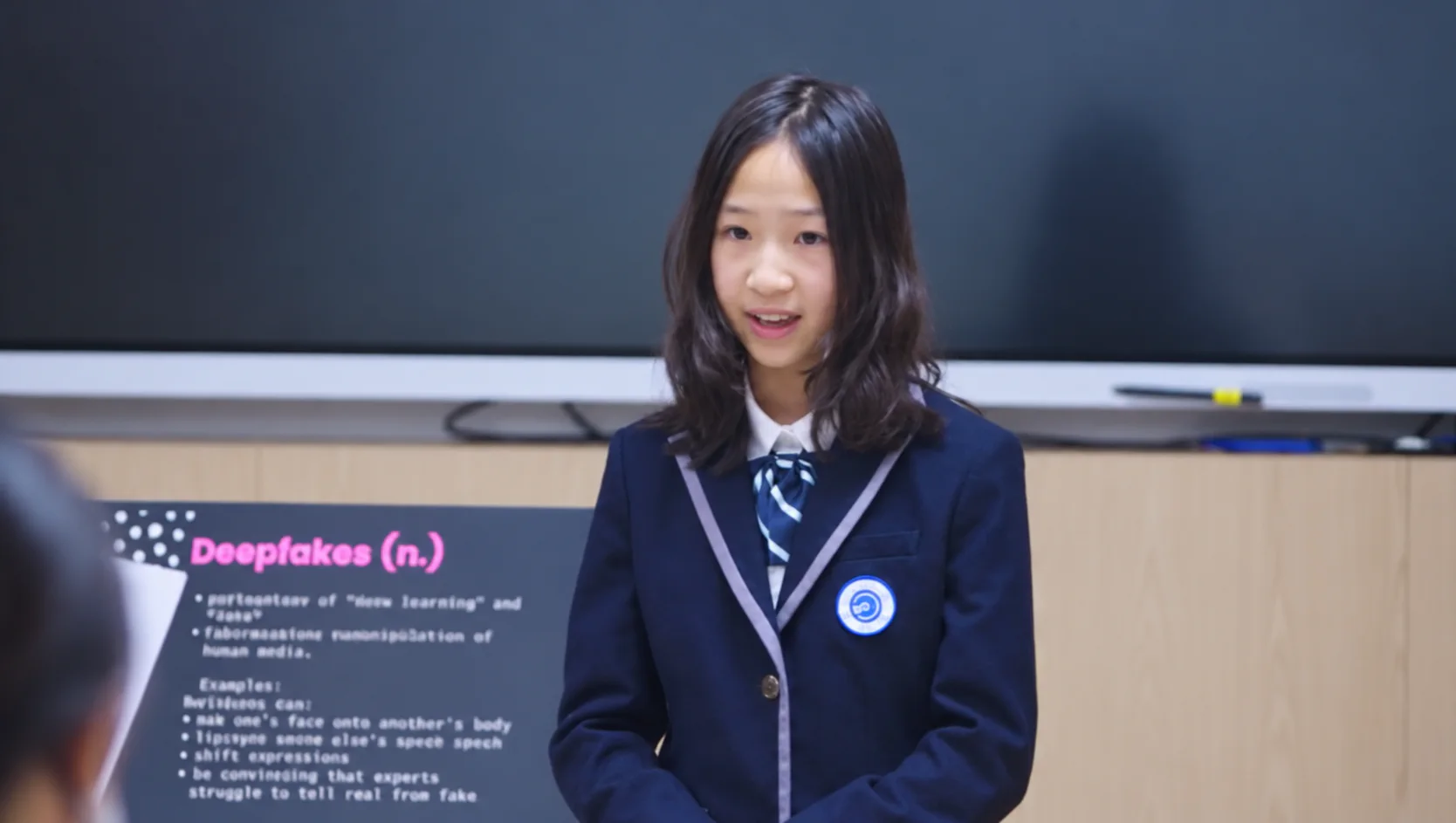
Speech
The Mirror That Lies: Deepfakes and Society
What happens when a video shows someone saying words they never said? In The Mirror That Lies, I presented an informative speech about deepfakes and their effects on society. I represented BASIS International School Hangzhou at the BBGM Speech & Debate Tournament in Shenzhen, where I reached the semifinals in Middle School Informative Speaking.
Through spoken explanations, printed visuals, and a mirror, the presentation explored how deepfakes work, why they matter, and how people can respond.
Starting with something that looks real
I opened with an imagined scene: a video of a world leader declaring war spreads online. People react before discovering that it is fake. The scene gave the audience a situation to picture before I introduced the technology behind it.
I then explained how AI can change faces, match lip movements to words, and imitate expressions. These changes can make a person appear to say or do something that never happened. This led into the speech’s main concern: how convincing images can affect our understanding of real events.
Looking at the effects on trust
The speech examined three areas: politics, personal privacy, and public trust. A fabricated video of a political figure could influence people’s opinions before it is corrected. Using someone’s face without permission can also damage their privacy and reputation. Even after a video is shown to be fake, its effects may continue.
Another important idea was the liar’s dividend. Once people know that realistic fake videos exist, someone can dismiss a real recording by claiming it was created by AI. This creates two problems: people may believe something that never happened, or reject evidence of something that did.
By explaining both, I showed how deepfakes can create uncertainty around genuine evidence as well as spread false information.
Making the idea visible
For the presentation, I used a wooden board, a mirror, a board marked “TRUTH,” and foam boards displaying printed slides.
The mirror gave the speech’s title a physical form. We usually expect a reflection to show what is in front of it. In the presentation, this familiar object became a way to introduce the difference between an image that looks real and one that can be trusted.
The printed slides provided visual support as I explained the topic. The “TRUTH” board accompanied the section about possible responses. Together, these materials gave the audience visual points of reference throughout the speech.
Considering possible responses
To conclude, I discussed legal responses, detection tools, and media literacy. The speech also addressed a challenge: as detection tools improve, the methods used to create deepfakes can develop further too.
I finished by explaining the importance of checking a video’s original source and looking for other evidence before trusting or sharing it.